12 min read
Implementing LLMs and machine learning in products that already have traffic, data, and compliance constraints. Covers retrieval, evaluation, and the operational work after the demo.

Sarah Jenkins
Principal Architect, Developer X

As enterprises scale their cloud-native deployments, the management of thousands of disparate microservices introduces unprecedented operational complexity. This guide explores the critical inflection point where traditional API gateways fail and Service Mesh architectures become imperative.
We analyze telemetry from over 500 enterprise Kubernetes clusters to outline a standardized approach for implementing zero-trust networking, progressive delivery, and deep observability without requiring application code changes.
Use this guide in a working group: assign one chapter per owner, mark the constraints you already have, and treat the PDF download as the shared artifact for architecture review — not as a substitute for a design that names your actual services.
In the early stages of microservice adoption, centralized API gateways serve as a functional choke point for routing and auth. However, as the number of internal services grows exponentially, routing all east-west traffic through a north-south gateway creates severe performance and reliability issues.
Latency and security gaps
Analyzing latency bottlenecks and security gaps in monolithic gateway patterns. A poorly placed gateway becomes a distributed monolith — the worst of both worlds.
Reduces hop count for east-west traffic
Keeps auth close to the service
Lets teams ship independently
Implementing mTLS by default across east-west traffic. Identity, encryption, and policy belong in the mesh — not in every application.
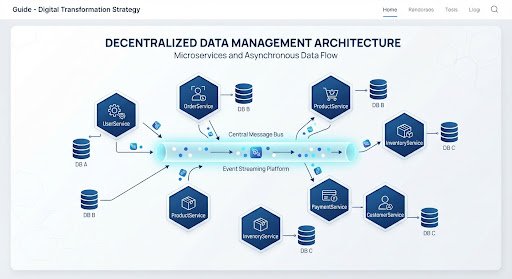
Mutual TLS, workload identity, and least-privilege authorization let you observe and control traffic without rewriting services. Progressive delivery then rides the same data plane.
Traces, metrics, and logs have to travel with the request, not live in five dashboards. Sidecar or ambient mesh collection lets you see east-west traffic without asking every team to instrument by hand. Alert on SLOs, not on CPU — a hot node is a symptom, a missed error budget is the product.
Canary and shadow traffic belong on the same data plane as mTLS. Start with 1% of a single service, compare golden signals, then widen. If you cannot roll back in minutes, you do not have independent deployability — you have a shared freeze with extra YAML.
Related Engineering Guides
Take it offline
Get the complete 48-page PDF guide including bonus architecture diagrams and checklists.
Download PDFDeveloper X provides the infrastructure and observability tools needed to safely scale your microservices architecture today.